About this article
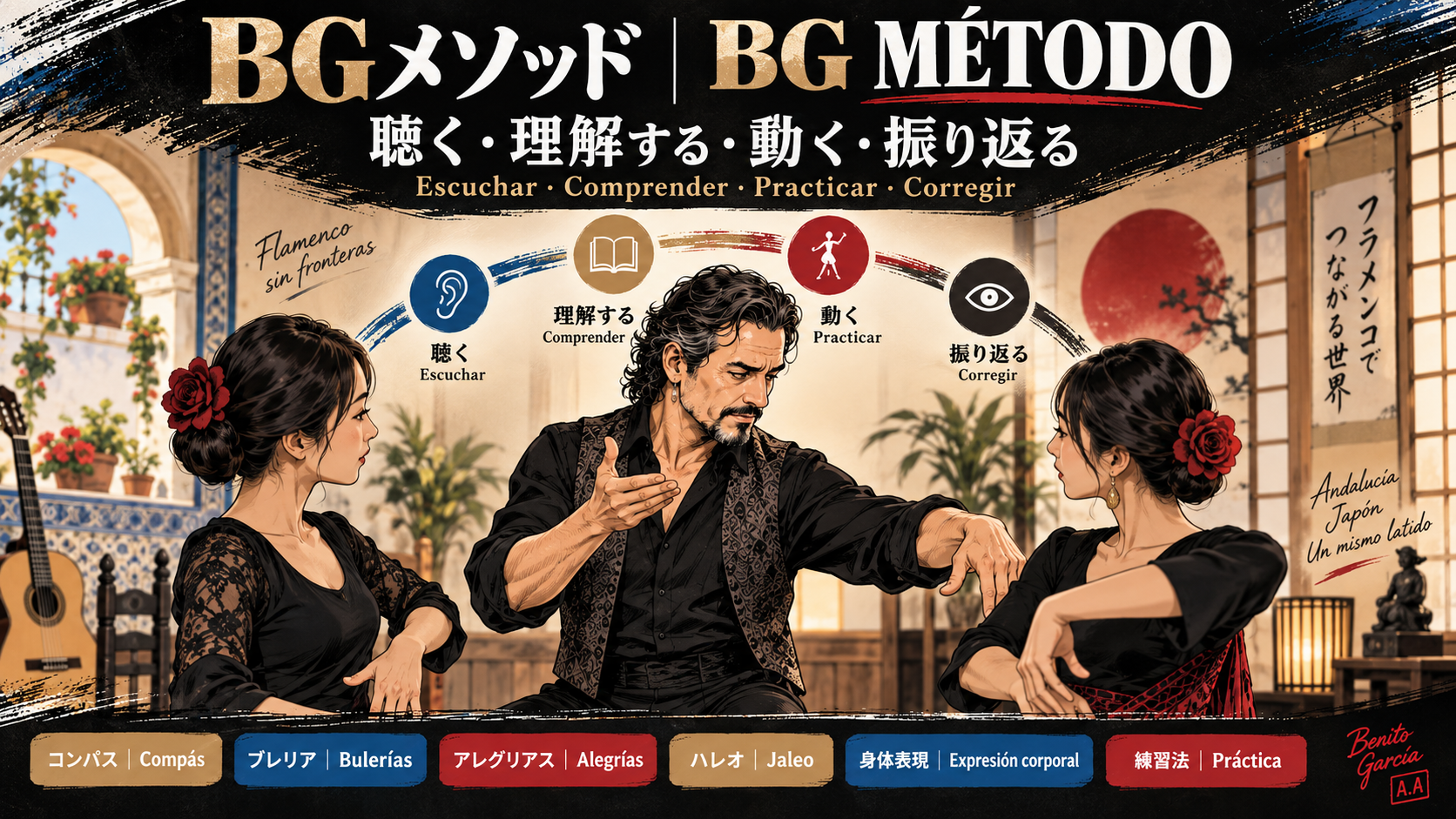
This article stems from the classes and broadcasts that Benito García has shared on the BG Flamenco YouTube channel. We've rewatched several videos and compiled ten ideas that can help you better understand and practice the dance.
We haven't copied everything from the videos word for word. We've explained each idea in simple terms and included a way to practice it, a common mistake, and how to correct it.
You don't need to learn everything at once. You can choose just one section, read it carefully, and try the exercises. At the end of this section, you'll find "Videos Used," with links to all the videos used to prepare the article.
What the archive reveals when viewed as a whole
These ten points are not isolated pieces of advice. They form a chain: listening to the rhythm helps you recognize the structure; recognizing the structure allows you to wait for the singing; waiting gives you time to position your body; and a well-positioned body can express an intention without accumulating steps. Therefore, the work is not just about remembering choreographies. It's about learning to relate to the music, to other people, and to your own body.
1. Compás is more than counting: it is sharing musical time
Counting the accents can be helpful, but the rhythm is more than just a series of numbers. It's the shared temporal space of the singing, the guitar, the handclaps, and the dance. A person can correctly count the numbers and still move before the singer finishes their phrase. They can also take many steps and give the impression that they aren't listening. The goal is for the movement to arise from within the music, not on top of it.
This matters because flamenco functions like a conversation. There are moments to propose, to sustain, to respond, and to remain silent. If the dancer fills every gap, the singing loses its breath; if she waits without maintaining the pulse, the energy drops. Presence emerges when the rhythm is maintained even in stillness.
Try three rounds. First, listen to one complete compás without moving. Next, mark only the pulse with a small weight shift. Finally, add a short marcaje, a basic movement that accompanies the singing. Record yourself and check whether you move before the musical phrase ends. A common mistake is rushing to avoid silence. Reduce the movement, breathe out, and let the next step follow the musical cue.
— ◆ —
2. The structure of the bulerías is understood through functions
Bulerías includes salida (an entrance), marcaje (movements that accompany the singing), remate (a concluding movement), and llamada (a cue for change). These are functions, rather than fixed-length sections that always follow the same order. Each introduces or receives the singing, sustains a phrase, concludes an idea, or signals a transition. In a fin de fiesta, the closing part of a gathering or performance, the length can change with each person's singing and contribution.
Understanding each movement's function is more useful than memorising a rigid sequence. When a sung verse lasts longer, a dancer who understands marcaje can continue it calmly. A clear musical ending helps the dancer prepare a remate or llamada. Choreography then becomes a flexible vocabulary, rather than a recording to reproduce exactly.
Practise the same llamada after a short musical phrase and a longer one. Before starting, quietly name what you are waiting for: the end of the sung verse, a remate, or a change in energy. A common mistake is moving on after the counts learned in class even though the singing continues. Return to a small marcaje, keep the compás, and listen for the actual end of the phrase.
— ◆ —
3. Good alignment prepares the body to dance
The instruction to "position yourself" doesn't simply mean straightening your back or striking a pretty pose. It involves feeling the ground with your feet, not locking your knees, aligning your pelvis and ribcage, releasing your breath, and directing your gaze. It's an open position: the body can move in any direction without first having to abandon a rigid posture.
Body alignment changes even the simplest movements. A small step with a stable body axis, a clear direction, and an intentional gaze can have presence; a large step with the weight held too far back can look uncertain. Good coordination also avoids unnecessary effort and lets the arms, torso, and feet work together.
To train this posture, stand with your feet comfortably positioned and find a balanced weight distribution. Exhale, relax your shoulders, and hold this position for four counts with your gaze forward. Then shift your weight without raising your arms. Pay attention to whether one hip shifts or your chest arches. A common mistake is to tense the knees, neck, and lower back to appear stable. The correct approach is to focus on an axis that rises from the ground and an intention that travels forward, without stiffening the body.
— ◆ —
4. Dancing con salero does not mean adding more steps
Con salero means dancing with natural charm, character, and an alert presence. It does not require a constant smile, large gestures, or a string of embellishments. Salero emerges when a simple movement has an audience, a direction, and the right timing. A well-placed pause can communicate more than several quick steps.
Dance the same marcaje in three ways: as a welcome, as a gentle challenge, and as quiet observation. Keep the sequence unchanged; adjust only your gaze, weight, breathing, and the length of a pause. When an observer sees the difference, it shows that expression comes from intention rather than the number of movements.
A common mistake is confusing character with exaggeration. When the face and hands try to show too much, movement loses its naturalness. Remove one embellishment, keep breathing, and choose an emotion you can sustain. Instead of asking what gesture to make, ask who you are addressing and what you want to express.
— ◆ —
5. Jaleo: rhythm and timing come before vocabulary
Jaleo means vocal encouragement that supports and shares the energy of a performance. Words such as olé are powerful when offered at the right musical moment. Memorising expressions is not enough. Listen to the end of a phrase, the completion of a remate, the singer's breathing, and the other performers' responses.
Keep a steady palmas rhythm and offer just one word of jaleo once per compás. Then leave space to listen. Record yourself and first check whether your palmas remain steady. If they lose their rhythm, speaking still takes too much attention. Watching performances and noting what happened immediately before each jaleo is also useful.
A common mistake is speaking continuously to hide nerves or show enthusiasm. Choose a sincere word, offer it at the appropriate moment, then listen again. Effective jaleo draws attention to the other performer's good moment rather than to the person calling out.
— ◆ —
6. Understanding the imagery in a sung verse gives movement a purpose
Many flamenco lyrics condense a place, a trade, a journey, a bell, a love, or a loss into just a few words. Images like a silversmith from Córdoba, a pilgrim, or bells are not mere decoration. They situate the emotion in a specific world. When you understand who is speaking, what they are remembering, and what image dominates the song, the interpretation ceases to be a general label of joy or sadness.
Before dancing, read the lyrics, look up unfamiliar words, and note three things: who might be speaking, the main emotion, and the clearest image. Then dance a single marcaje while imagining that scene in front of you. You do not need theatrical hand gestures: a coherent gaze, breathing, and a meaningful pause can be enough.
A common mistake is using the same expression for every sung verse. Move away from the vague instruction to feel more and return to a specific word. If its historical or linguistic meaning is unclear, ask or consult a reliable source. Acknowledging uncertainty is better than inventing an interpretation.
— ◆ —
7. Alegrías becomes more adaptable when you recognise its musical landmarks
Alegrías is related to cantiñas and jota. Its bright character does not erase its history or the variety of its forms. A dance may contain a first letra (sung verse), an optional falseta (guitar passage), a second letra, a subida (increase in tempo or intensity), a remate (concluding movement), a silencio (quieter section), and short or long coletillas (additional ending phrases). These are landmarks, rather than sections guaranteed to last a fixed number of seconds.
Recognising these landmarks helps you adapt. During a letra, accompany the singing without covering it. In a subida, listen for the increase in tempo or intensity. A silencio changes the musical texture and calls for a different movement quality. Practise shorter and longer versions of the same structure, naming the cue that marks each transition.
Relying only on the choreography's duration can cause confusion when the singer extends a phrase. Continue serving the current section's purpose, maintain compás, and wait for the singing or guitar to cue the next section.
— ◆ —
8. A specific question helps you make the lesson your own
Both teacher and student shape a lesson. When a student describes a difficulty precisely, the teacher can identify its cause more easily. Saying “I do not understand anything” gives less information than “I cannot hear where the second musical phrase ends” or “My shoulder rises when I put weight on my right foot”. A specific observation gives you something to examine and correct.
After practicing, it's helpful to jot down three lines: where the problem occurred, what the body did or what sound was heard, and what sensation arose. In the next class, choose a single question and immediately test the answer with a small movement. In this way, the verbal explanation is connected to the physical experience.
Many adults worry about using the right technical term. You do not need perfect terminology. Add one detail that can be checked: right or left, the beginning or end of a musical phrase, speed, sound, balance, or pain. Instead of asking a very broad question, identify the moment and what happens there.
— ◆ —
9. When conditions are limited, keep the goal and adapt the method
It is not always possible to practise in flamenco heels, make noise, travel across a large room, or fully open a fan or mantón shawl. These limits do not prevent learning. When you cannot practise zapateado, or footwork, work on the torso, arms, gaze, breathing, and musical memory. In a small space, reduce travelling movements and pay attention to your body axis.
Begin by naming the day's goal. For compás, use soft palmas and weight shifts. For expression, choose an image from the lyrics and a direction for your gaze. For a prop, practise holding it and moving it along a safe path. The exercise becomes smaller while its learning purpose remains.
The mistake lies in trying to replicate the same amplitude and power of the studio at home. This can lead to bumps, strain, or frustration. The solution is to check the floor, the space, your footwear, and your physical condition. Any movement that causes pain should be stopped. Adapting isn't giving up; it's a skill that allows you to continue for years.
— ◆ —
10. Improvement needs continuity, concrete objectives, and recovery
Current experience alone doesn't determine how much one can learn. Experience, physical condition, clarity of goal, and consistency all play a role. For many people, practicing for twenty minutes several times is more sustainable than doing one very long session and becoming exhausted. Recovery time isn't wasted: it allows the mind and body to assimilate the work done.
Choose a goal you can observe. Instead of saying I want to dance better, try: this week I will wait for the musical ending before making a llamada, or in two weeks I will be able to explain the landmarks of the first sung verse. Note your fatigue after practising. If strong fatigue remains the next day, reduce the amount or difficulty.
A common mistake is to think that stopping always shows a lack of willpower. In reality, rest, sleep, and slow practice are all part of the process. If there is persistent pain or a concerning issue, you shouldn't force yourself to dance and should seek appropriate professional guidance. The goal is to learn in a lasting way, not to push your body to its limits in a single session.
20-minute guided practice
Minutes 0–4: listen without doing any steps. Follow the pulse mentally and notice where the musical phrases end.
Minutes 4–8: maintain compás with gentle palmas or weight shifts. Check that your breathing stays free.
Minutes 8–12: choose one topic from this article and practise it with half your usual movement size and effort.
Minutes 12–16: add just one expressive element: an image from the lyrics, a direction for your gaze, or a well-timed word of jaleo.
Minutes 16–20: record one attempt. Write down what worked, where you rushed, and what you will adjust next time.
Conclusion
These ten lessons share one principle: before adding difficulty, listen, organise your body, and understand each movement's purpose. Compás, structure, presence, salero, jaleo, lyrics, questions, adaptation, and rest work together. Choosing one point, practising it briefly, and observing the result gives clearer progress than trying to fix everything at once.
Videos used
These are all the videos used to develop this article's explanations and exercises. As verified timestamps are unavailable here, the links lead to the complete videos without invented time markers.
Gakkou de Flamenco · Vol. 2 (recorded in two languages)
Rehearsal with BUYOUDAN
Gakkou de Flamenco · 3 October (recorded in two languages)
DON BENITO · Christmas special
Answering your questions (1)
Answering your questions (2)
Bulerías class · Vol. 04 (members only)
What is alegrías? (explained in Japanese)