
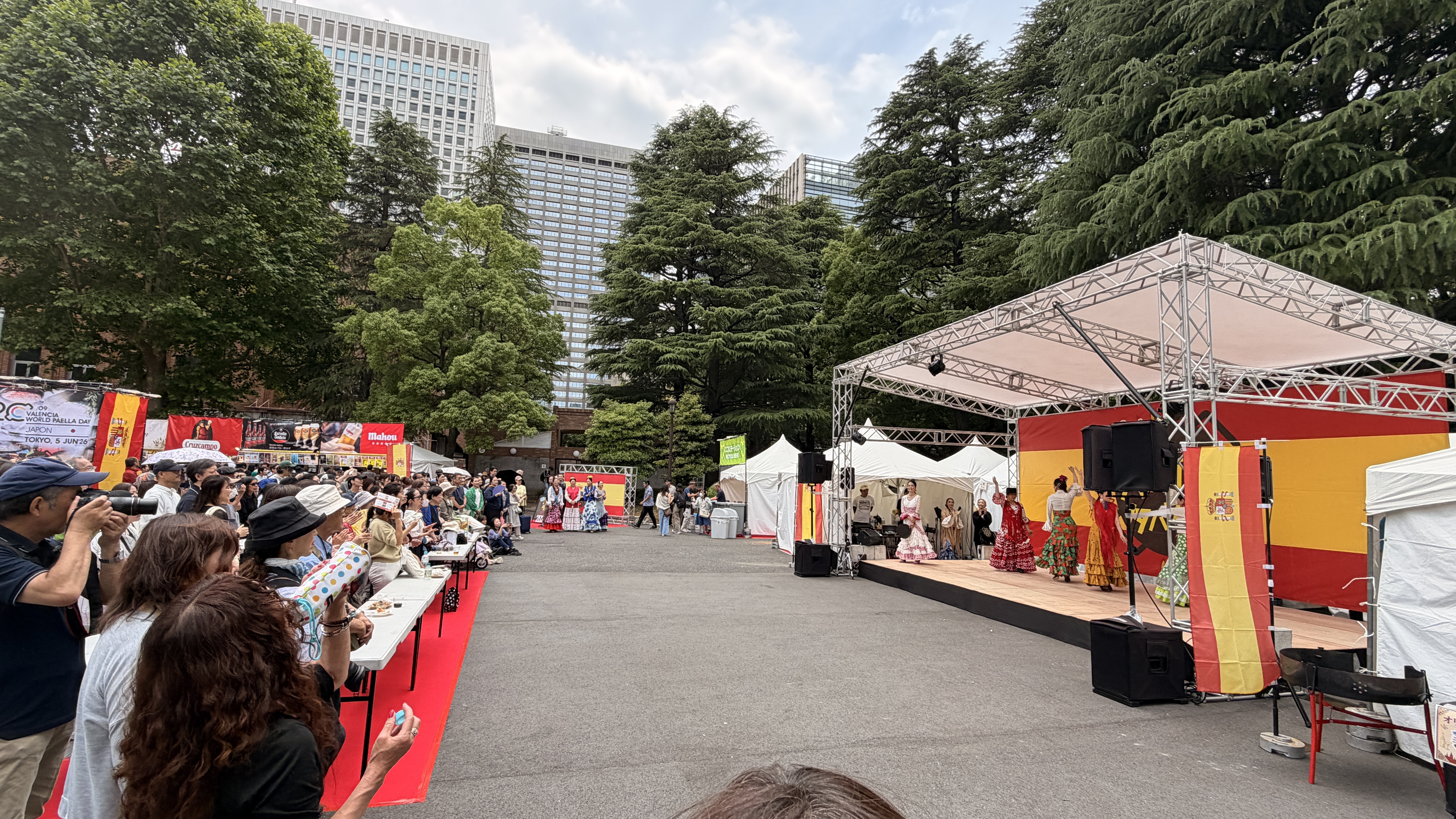
A day at Hibiya Park when Spain came alive through aromas, flags, smiles and our students' dancing, bringing flamenco to Japanese audiences as a lively, approachable and shared experience.
Spain appeared for a day among Hibiya's trees
Some days, a city takes on a different accent.
Tokyo was still Tokyo: orderly streets, a precise rhythm, a quiet way of moving even when crowds gather. Yet the air changed as we reached Hibiya Park. There was the aroma of Spanish food, lively stalls, Spanish flags everywhere, conversations, smiles, music and curiosity. It was that special atmosphere created when one culture finds a place within another, simply by being alive.
On Saturday, June 6, 2026, BG Flamenco Academy took part in the Paella and Tapas Festival at Hibiya Park. It was a bright, warm day full of participation, a reminder that flamenco does not live only in theatres and studios. It can also appear in a square or a park, beside a food stall, among families, curious visitors and people encountering it for the first time.
The festival brought together many of Spain's flavours and symbols: paella, tapas, Spanish products, flags, colours and that cheerful little bustle we sometimes need so much. Amid it all, our students took to the stage to share their dancing with the audience.
It was more than a performance.
It was a way of saying: this is part of Spain too. This can be experienced here in Japan too. This can feel close to you too.
— ◆ —
BG Flamenco Academy's participation was organised around two planned sets, from 11:30 to 12:30 and from 16:30 to 17:30. The students danced to recorded music, presenting choreography developed for the current end-of-year recital or drawn from earlier editions. That gave the stage a special meaning: these were not pieces prepared solely for a festival, but a real part of the academy's artistic and educational journey.
What usually begins in the studio, develops through rehearsals and reaches the theatre was able to meet a wider audience that day, right in the heart of Tokyo.
The students danced with heart and concentration, bringing that beautiful blend of feelings that emerges when studio work goes out into the world. In class, you learn a posture, a step, an entrance, a llamada, a gaze. But on an open stage, before people who may not know flamenco, it all changes. It is no longer just about doing it well. It is about communicating.
And that day, the connection came through.
The audience approached, watched, smiled and joined in. Little by little, the stage stopped feeling like a separate place. There was rhythmic clapping, there were voices, there was participation. People responded joyfully to those shared moments, creating a very special atmosphere, as though, for an instant, the dancers and those watching were breathing together.
— ◆ —
Alongside the performance, we wanted the audience to experience some distinctive elements of flamenco in a simple, approachable way. So we introduced the call of '¡Olé!' It is not decoration: it is a way of encouraging, accompanying and recognising something happening in the moment.
We also introduced familiar flamenco accessories: palillos, or castanets, the fan and the Cordoban hat.
Each of these has a world of its own.
Castanets are not just a sound: they involve precision, rhythm, coordination and character. A fan is not just a beautiful object: it can reveal an intention, a pause, a line, a way of breathing. The Cordoban hat is not just a recognisable image: it brings presence, elegance and a way of holding the body. And '¡Olé!' is not merely a Spanish word familiar in Japan; it is a small doorway into a different way of looking at art.
Perhaps that was the loveliest part of the day: watching people who had come to enjoy a food festival become part of a flamenco experience too. Some clapped, some smiled, others closely observed the accessories, movements and gestures. Suddenly, without lengthy explanations, flamenco became something they could understand.
Not because it was diminished.
But because it was shared.
— ◆ —
There was also a short open class for the public: a simple, direct moment that invited people not just to watch from outside, but to feel some of flamenco's movement, energy and joy in their own bodies. At an event like this, that closeness matters. Sometimes the best way to understand a culture is not to hear a long explanation, but to try a gesture, clap your hands, say '¡Olé!' and feel that you too belong to that moment.
For BG Flamenco Academy, events like these have special value. The academy is more than a place where classes are taught. It is a space where many Japanese students study, work, make an effort, repeat, make mistakes, start again and gradually find their own way of expressing themselves through flamenco.
When that process leaves the studio and reaches a wider audience, something important happens. The students show more than choreography. They also show the journey behind it: hours of classes, rehearsals, corrections, nerves, anticipation, responsibility and the joy of dancing for others.
At Hibiya Park, that journey became visible.
— ◆ —
And so did something that has been at the heart of BG Flamenco Academy for many years: the bridge between Andalusia and Japan. Not as a pretty phrase, but as an everyday reality. An Andalusian teacher teaching flamenco in Tokyo. Japanese students dancing with respect and dedication. A Japanese audience listening, participating and responding. Spain present in a Japanese park through food, music, dance and shared emotion.
That bridge is not built in a single day.
It is built class by class, rehearsal by rehearsal, event by event. It is built when a student dares to step onto the stage, when someone in the audience claps for the first time, when a person says '¡Olé!' with a smile. When flamenco no longer seems distant and becomes something you can feel in your body.
That is why taking part in the Paella and Tapas Festival meant more than a performance on a programme.
It was a small celebration of everything flamenco can open up.
To everyone who came to watch, joined in with claps and voices, looked on with curiosity, supported the students or helped make this encounter possible: thank you.
We will keep sharing flamenco from the studio, from the stage and from those unexpected places where, suddenly, a city takes on a different accent and Spain appears for a moment among Tokyo's trees.
— ◆ —
Highlights
Flamenco does not live only in theatres and studios; it can also appear in a park, among families, smiles and people discovering it for the first time.
The students showed more than choreography. They also showed the journey behind it: classes, rehearsals, nerves, anticipation and the joy of dancing.
For an instant, the stage and the audience breathed together.
— ◆ —
Related links
WhatsApp enquiries
Official TikTok
Book a visit or trial lesson