
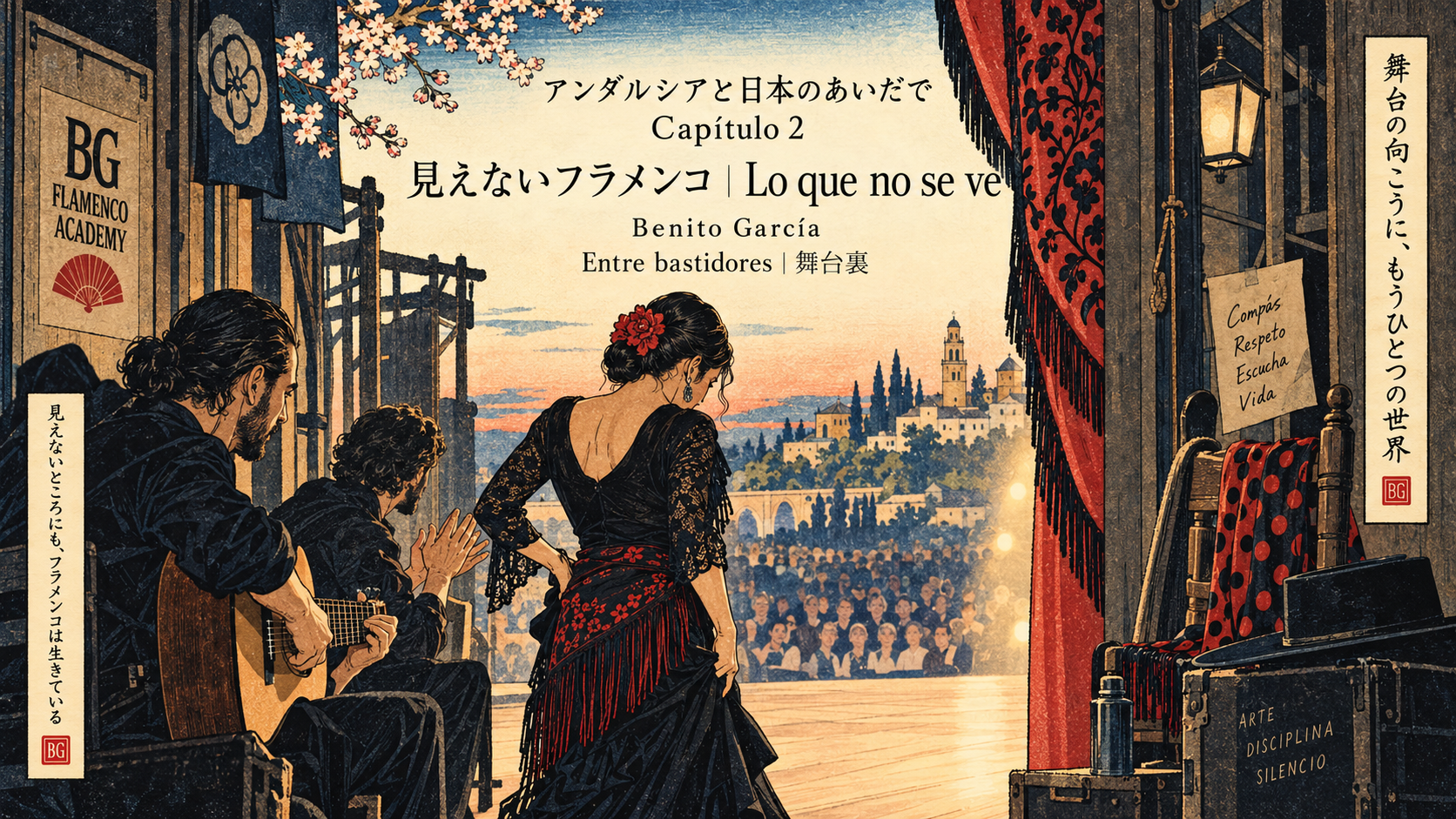
What the audience cannot see
What happens inside flamenco while the audience watches.
I often wonder what people really see when they watch flamenco. They see a dancer, a guitar; they hear a singer. They see strength, movement, compás, choreography, an escobilla, a remate. Of course, all of that is there. But so much more happens within the stage, including things that are sometimes difficult even to explain.
After so many years dancing, teaching and living among flamenco, one thing becomes clearer to me: watching flamenco from outside and being inside it are very different experiences. I do not mean better or worse. Simply different.
— ◆ —
Compás
The audience listens to the music. So do we. But from within, compás is not just following a rhythm. For me, it is like being inside a place. You know where you are, where you can enter, where you must wait, where you can push and where you can leave room to breathe. You also sense when something is being prepared, even before it happens.
From outside, it may look as though we are doing steps over music. Inside, however, we are listening to many things at once and making decisions all the time.
— ◆ —
Not everything is written
Sometimes the audience may think everything we do has been prepared. Yes, there is a structure. There are rehearsals and things we know. But having a structure does not mean that everything happens exactly the same way. It does not.
The singer may do something different. The guitar may breathe differently. I may feel that I should not enter yet, that I should enter sooner, or that we need to wait. This is one of the most beautiful things: we are working with something alive. To truly improvise, you need to know a great deal. It is not doing whatever you like. It is knowing where you are so that you can move within it.
— ◆ —
The glances
You can hardly see this from outside, but we look at one another a great deal. A glance can clearly say: “Now.” “Wait.” “Keep going.” “I’m coming in.” “I’m finishing.” We do not need to speak.
Sometimes the audience is watching a powerful moment in the dance while something far smaller has happened between us: a glance. With that, everything has been said. I love this part, because you feel that you are not dancing alone. You are talking with the others.
— ◆ —
Knowing when not to act
This is difficult to understand, especially when you begin. We sometimes believe that dancing well means doing a lot: lots of footwork, lots of arm movements, lots of strength, lots of remates. But not always.
Sometimes the hardest thing is to do nothing. To wait, listen, stay still, let the singer finish, let the guitar speak, and avoid entering where you are not needed. It is difficult, because silence is also part of flamenco. Often a well-placed silence has more power than twenty steps.
— ◆ —
The step is not everything
I often tell my students this. You can learn a step perfectly, do the same movement as me, place your arm in the same position and make the same strikes. Yet that does not mean we are dancing the same thing. Something is missing: intention.
Why are you doing that step? What are you saying? Where are you going? Are you attacking, waiting, accompanying, breathing? Two people can do exactly the same thing, and one can say something while the other does not. That is why, for me, flamenco can never be only about learning choreography.
— ◆ —
The difficulty is making it look natural
Some things look easy to the audience: walking, stopping, raising an arm, turning, standing still and looking. Often these things are extraordinarily difficult. Making something look natural requires an enormous amount of work behind it: balance, strength, control, endurance, coordination. Hours. Years.
The body learns little by little. Then a moment comes when all that work has to disappear. It cannot look as though you are thinking about twenty things. It must look as though you are simply there. That is very hard.
— ◆ —
Listening to the singer
For me, this is essential. You cannot dance thinking only about the choreography. If you are waiting for your step and not listening, you are already outside the moment. You must listen to how the singer breathes, begins a verse, stretches it and finishes it; where they push, where they ease off, and where they leave you space.
Sometimes you have planned something, and the cante makes you change it. That, for me, is flamenco. Not saying, “Now it is time for this step,” but, “This is what is happening now, and I need to be part of it.”
— ◆ —
Fear goes onstage with you
The audience sees the artist already onstage. From outside, you may appear completely confident. Yet before going on, all kinds of things can pass through your mind: nerves, doubts, fear, that strange breathing just before you enter.
I do not think experience makes all of that disappear. You learn to live with it. Then the moment comes when you have to go on. Confident or not. Afraid or not. You go on. That is where everything begins.
— ◆ —
What you take home
At the end of a performance, the audience applauds, and that is lovely. But often what I remember afterwards has nothing to do with the applause. It may be a tiny moment: a glance, a silence, something the singer did, a response from the guitar, or the feeling that we were all in the same place.
It may even be something that went wrong and that we managed to resolve together. Perhaps nobody saw it. But we did, and it stays with us. I often take those things home, rather than necessarily the most spectacular moment: that instant when something real happened.
— ◆ —
Flamenco is much more than dance, singing and guitar
When we try to explain flamenco, we always say the same thing: dance, singing and guitar. That is fine. But for me, flamenco is much bigger. There is a way of speaking, shared codes, ways of looking at one another, respect, ways of accompanying, and memory.
Some people teach you things without sitting you in front of a blackboard. Some things you learn after seeing them a hundred times; others you understand suddenly one day. Flamenco also changes and evolves. It is not dead. It is alive. Perhaps that is why it is so difficult to fit all of it into a definition.
— ◆ —
What often goes unseen
In the end, the audience sees the dance and hears the singing and the guitar. But onstage, many other things are happening. We are listening, talking without speaking, hesitating, waiting, deciding, feeling fear, controlling our bodies and leaving space for one another. All of it happens in seconds.
For me, flamenco is not only what is visible. It is also what happens between us. Perhaps that is one of the things I still love most after so many years. You can study, rehearse and prepare a great deal. But when the real moment comes, something cannot be fully prepared. It has to happen. And when it does, even if the audience cannot explain exactly what happened, they feel it.
— Benito García —